
29 Delicious Thai Fruits You Must Try (And How to Eat Them)
Cat is Out of the Office contains affiliate links and is a member of the Amazon Services LLC Associates Program. If you make a purchase using one of these Amazon links, I may receive compensation at no extra cost to you. See my Disclosure Policy for more information.
You cannot visit Thailand without enjoying the tropical Thai fruit – it’s against the rules, and the Immigration Office won’t let you leave (I kid, I kid).
I’ve spoken to countless travelers who are apprehensive about trying unfamiliar fruits, and I understand the feeling. It’s one thing to find a new Thailand fruit to taste, but it’s another to know what it is and how to eat it!
As someone who has had the pleasure of backpacking all over Thailand and then living in the vibrant city of Chiang Mai in Northern Thailand, I’ve been lucky enough to taste all of the different fruits from Thailand. Every week, wherever I am, I head to the fruit market where the locals shop (where you’ll find the best quality at the best price) – and I am almost always the only foreigner there.
I once took a tour of a fruit market in El Salvador that introduced me to so many new and interesting fruits I had never seen before. Since then, I have aimed to try as many new and obscure fruits as I can find when I’m traveling.
Thailand’s climate is perfect for growing some of the most delicious tropical fruits in the world. And eating fruit in Thailand is one of the best ways to stay hydrated in the unforgiving heat.
Some fruits you have to taste are the famous stinky fruit of Thailand (Durian), the juicy mangosteen, the tart snake fruit, the sweet rambutan, and my personal favorite, pomelo – each fruit has something to offer, and I’ve been fortunate to experience them all.
I’m here as your fruit-loving fairy godmother to guide you on this fruity adventure. Trust me, your taste buds will thank you.
👉 One of my favorite ways to learn about local food and fruit when I’m traveling is to take a food tour or cooking class. Tours are a really fun way to meet other travelers, and I find food tours to be more social than other types of tours.🧑🍳🥘🍜🍡🌶️
1. Mangosteen: The Queen of Thai Fruits

Often called the “queen of fruits,” in Thailand, the Mangosteen is one of the most popular Thai fruits – and for a good reason – it’s delicious!
Beneath its tough, leathery purple shell is a delicious white flesh with a perfect balance of sweet and tangy flavors. It kind of looks like a fruit version of garlic, but tastes like if a lychee and a peach had a baby.
Its round shape hides 5-8 segments of fruit, with the larger ones housing a hard seed that you should remove. It’s tart and sweet, perfectly balanced.
Pro Tip: A clever trick to know the number of fruit segments is to count the petals on the bottom of the shell! My mind was blown when I learned that.
Apart from its taste, locals believe that Mangosteen has a cooling effect on the body, making it the perfect antidote to Thailand’s tropical heat.
How to Eat Mangosteen: Use a serrated pairing knife if you have one to carefully cut into the thick skin without puncturing the delicate fruit inside, cutting around until you can open it up. Professional mangosteen-eaters don’t use a knife at all – they lightly squeeze the mangosteen eaters until it sort of pops open on its own, but the first time I tried this way I smashed the fruit, so be gentle!
Thai Name for Mangosteen: Mangkut (มังคุด)
Mangosteen Season in Thailand: March to September
2. Durian: The King of Thai Fruits

Durian is not just a smelly fruit in Thailand; it’s a cultural phenomenon. Not just in Thailand, but in Vietnam and the rest of Southeast Asia, too.
It’s earned the moniker “King of Fruits” due to its size and unique flavor profile, but it’s also notorious for its pungent odor, described as everything from rotting flesh to moldy gym socks.
Yet, if you can hold your nose and venture past the initial smell, you’re rewarded with a sweet, silky fruit that hints at a custard-like flavor with undertones of almonds. This unique taste experience has led to a million different durian-flavored products dominating Thai markets, from ice cream all the way to specialized durian cafes.
However, be advised – its potent smell has led to it being banned in most public spaces, so you’ll often see signs prohibiting durian in hotels and on airplanes. Also, it’s considered the most expensive of all Thai fruits, with a small portion often costing several hundred baht.
But fear not, many markets offer smaller, more affordable portions wrapped in plastic, offering a chance to taste this king of Thai fruits without buying the whole fruit.
How to Eat Durian: The best way to eat Durian is to let a local vendor open it for you – they are experts at breaking the thick rind without smashing the soft fruit inside. Once opened, you’ll find several chambers containing a custard-like pulp. Use a spoon to scoop out the sweet flesh, being cautious of the large seed in the middle.
Thai name for Durian: Turian (ทุเรียน)
Durian season in Thailand: April to August is prime durian season, but it can be found all year round.
⭐️My pick for Best Bangkok Food Tour is this Bangkok Midnight Food Tour by Tuk Tuk with a near-perfect 5-star Rating.
3. Langsat (Longkong)

Next on our list of Thai fruits to savor is the Langsat, also known as Longkong or Lanzones in other parts of the world. Longkong is popular in Thailand and one of the most popular fruits in all of Southeast Asia!
Resembling a small round potato in appearance, the Langsat has a thin, pale brown skin that encases a translucent, juicy flesh. The fruits are often clustered together like grapes on a vine.
The Langsat fruit is firm to the touch but can easily be broken open with fingers, and peeled open. Inside, you’ll find 4-5 fruit segments each offering a burst of sweet flavor. It kind of tastes like a lychee. Before you know it, you’ll have eaten the whole bunch!
A fun fact to remember – the smaller the segment, the sweeter it is! Larger segments typically contain a seed, but be cautious not to bite into it as it can be quite bitter.
In Thailand, locals often refer to the thin-skinned variety as Langsat and the thick-skinned ones as Longkong, but they’re more or less very similar.
How to Eat Langsat: Simply tear open the skin with your fingers, and enjoy the sweet segments inside. Remember to avoid the large seed in the center!
Thai name for Langsat: Langsat (ลางสาด)
Langsat season in Thailand: The best time to enjoy Langsat in Thailand is between July and September, although it can be found in some parts of the country year-round.
4. Dragon Fruit

The Dragon Fruit, also known as Pitaya or Pitahaya, is one of the most photogenic Thai fruits, but I’m always surprised that the flavor doesn’t match the appearance.
Originating from cactus plants, this fruit is also found in locales such as Central America, India, and the Caribbean.
The Dragon Fruit is easily recognizable with its unique reddish-purple exterior and greenish fins or “horns.”
There are many colors of dragon fruits: if the “horns” are more yellowish in color, you’ll find a white dragon fruit within. If the “horns” are more green, you’ll find the purple dragon fruit inside. The flesh – either white or purple – is soft (almost like a kiwi) and dotted with small, edible black seeds.
There’s also a yellow-colored variant of this fruit, but it’s a rare find.
Pro Tip: If you’re looking for a sweeter variety, go for the purple dragonfruit (more green on the outside); be warned, the deep purple color of the fruit inside stains.
How to Eat Dragonfruit: Eating Dragon Fruit is simple. Just slice it in half and scoop out the flesh with a spoon, or cut it into pieces for an exotic addition to any fruit salad.
Thai name for Dragon Fruit: Gao Mung Gorn (แก้วมังกร)
Dragon Fruit Season in Thailand: If you want to taste the freshest Dragon Fruit, plan your visit between April and October, which is the peak Dragon Fruit season in Thailand.
These Are My Favorite Tours in Bangkok
Rather than taking a taxi everywhere, consider taking one of these awesome tours!
Tours are a great way to explore the city, meet other travelers, and learn about Thailand’s culture.
🕍 Bangkok: Ayutthaya Historical Park Full Day Small Group Tour 👈
🕍 Bangkok: Night Tour of Temples, Markets, and Streetfood by Tuk Tuk 👈
🌆 Bangkok: Night Food Tour by Tuk Tuk 👈
🛶 Bangkok: Train Market & Floating Market 👈
🛶 Bangkok: Canal Tour On Longtail Boat 👈
👉 Explore All The Best Tours In Bangkok Here! 👈
5. Guava

The guava, known locally as “Farang” (ฝรั่ง), is a common fruit in Thailand and is cherished for its crisp texture and subtly sweet flavor.
The word “farang” is the same word as “foreigner,” and is probably named for the foreign traders who brought this fruit to Thailand from Central America and the West Indies.
Its exterior is usually a light green color, while the inside is either white, pink or even a deep red, depending on the variety.
The fruit is round, the size of an apple, often colored like a pear, and houses small, hard seeds in its center, which are perfectly edible. Guava is crunchy, similar to a firm apple but with a slightly thicker skin, and a little sour.
Locals love dipping guava in a mixture of salt, sugar, and chili for a thrilling balance of sweet, sour, and spicy.
If you ever see guavas – or any fruit in Thailand for that matter – that look unnaturally colored, avoid them! Some vendors dip fruits in a sugar dye. Stick to the natural fruits in Thailand.
How to Eat Guava: In Thailand, guavas are typically eaten raw. Cut into small pieces like you would cut an apple, and enjoy with a flavorful dipping sauce. It’s also a popular ingredient in fresh fruit salads and smoothies.
Thai name for Guava: Farang (ฝรั่ง)
Guava Season in Thailand: Guavas are available in Thailand all year round.
6. Pomelo

Resembling a grapefruit but significantly larger, this Thai fruit is wrapped in a very thick rind that can be a bit of a challenge to peel. If you’re seeking convenience, consider buying them pre-peeled at large fruit markets; just avoid the tourist markets where they tend to be overpriced.
Once you’ve conquered the rind, you’ll find the segments pull apart easily, and the seeds are simple to remove. The inside color varies, much like a grapefruit, with the most common being a yellowish-orange hue. However, my personal favorite are the pink ones – they taste sweeter to me.
Pomelos are juicy, offering an enjoyable balance of sweet and sour flavors. Unlike a grapefruit, you’ll find that a pomelo doesn’t need any added sugar – it’s a lot less bitter.
Pomelo fruit in Thailand is a beloved treat among locals, who often enjoy it with a mixture of salt, sugar, and chili. Additionally, it’s a common ingredient in many Thai salads.
When I first moved to Chiang Mai, I was buying overpriced ready-to-eat pomelo at the fancy market in Maya Mall, before realizing how much cheaper you can buy it at the fruit market where locals shop. Lesson learned!
How to Eat Pomelo: Peel the pomelo like an orange or grapefruit (although it’s a little harder because of the thick peel). Remove the seeds and enjoy!
Thai name for Pomelo: Som-O (ส้มโอ)
Pomelo Season in Thailand: Thankfully, pomelos are available all year round in Thailand, so no matter when you visit, you’ll be able to savor this delicious Thai fruit!
🤩 My favorite way to get to know a new city is by taking a food tour. This Northern Thai Food Tour will change your life. You’ll try hidden restaurants, street stalls, and local markets that most tourists never find and be transported in an iconic red rod daeng truck with a small group of hungry travelers. Come hungry because you’ll be trying more than 15 different dishes!
7. Tamarind

Among the many exotic fruits of Thailand, Tamarind stands out – it barely even looks like a fruit if you’ve never seen it before.
This pod fruit, native to Africa, is now a staple fruit in Thailand.
Its outer layer is hard, akin to a dried bean, and if you shake the Tamarind, you can hear it rattle. Something delicious is inside!
When you crack open a Tamarind, the inside reveals a sticky texture that is similar to that of a date.
Freshly picked, it has a sour taste; but when it dries a bit, it turns sweet.
In Thai cuisine, Tamarind is often used in sauces, popular dishes, and even candies. It is the secret ingredient that gives Pad Thai its unique flavor!
How to Eat Tamarind: Crack open the hard outer layer with your hands, remove the seeds from the sticky interior, close your eyes, and savor the deliciousness.
Thai name for Tamarind: Makam (มะขาม).
Tamarind Season in Thailand: The sweet tamarind is usually available from November to February, while the sour version can be found all year round.
8. Lychee

Lychee, pronounced as “lai-chee” (although most of my friends in the US say “lee-chee”), is another extraordinary fruit you must try when visiting Thailand.
Originally from China, this fruit has found a home in the heart of Thailand.
Its rough red exterior, slightly larger than a rambutan or longan, can easily be pushed open to reveal a succulent, super-sweet interior. Although longan may be even sweeter, the unique taste of lychee is something that will make your taste buds dance.
Not a fan of fresh lychees? You can also find canned lychees in sweet syrup, which are often used in various Thai desserts. And in one of my favorite cocktails, the lychee martini.
How to Eat Lychee: Peel open the lychee with your hands, pop the whole thing in your mouth, and remove the seed with your tongue like you would a cherry. Is it just me, or do your hands always get super sticky from the lychee juice, too?
Thai name for Lychee: Linjee (ลิ้นจี่).
Lychee Season in Thailand: The best time to enjoy lychee is from April to June.
👉 My pick for the best 5-star food tour that includes a tour of Warorot Market is this Half Day Small Group Tour with Local Foodies.
9. Rambutan

Looking at the rambutan, you’d be forgiven for thinking it’s a mythical creature’s egg. It has a charming, red and yellow rind covered in green hairs, giving it an exotic, strange, and uniquely appealing look.
This Thailand fruit’s name actually comes from the Malay word “rambut” which means “hair”, perfectly describing the soft spiky hairs covering the rambutan’s rind.
Beneath this unique exterior hides a firm, white, translucent flesh, similar in texture to a lychee or longan. However, the taste is a little less sweet than the lychee and longan, yet offers its own uniquely refreshing and subtle sweetness that your taste buds will relish.
Bear in mind, that the rambutan can be tricky to separate from its large seed – locals are quite adept at this. But don’t let this deter you from tasting this magnificent fruit!
How to Eat Rambutan: Peel away the thick rind with your hands to reveal the edible flesh. Carve it away from the seed, pop it in your mouth, and savor the unique flavors of this Thai fruit.
Thai name for Rambutan: Ngor (เงาะ)
Rambutan Season in Thailand: The best time to enjoy rambutan is from May to September.
👉 Find the best local tours with this search engine (and the best deals)!
10. Longan

Longan, another gem among the Thai fruits, is closely related to rambutan and lychee. However, it leans towards an even sweeter side, making it a favorite among sweet-tooth enthusiasts exploring the fruits of Thailand.
This fruit is wrapped in a thin pale brown skin that can be easily broken open with your fingers to reveal the sweet, juicy fruit inside. Just pop the whole fruit into your mouth, enjoy the burst of sweetness, and spit out the seed. I find longan easier to eat than rambutan.
Longan is grown in abundance in the Chiang Mai region (just another great reason to visit my favorite city in Thailand). The fruit’s name originates from Cantonese, meaning “dragon eye” – a nod to its appearance which resembles an eyeball (what’s more appetizing than that?).
When you bite into the translucent flesh, you can see the black seed inside, enhancing the dragon eye illusion.
How to Eat Longan: Break open the skin with your fingers, pop the whole fruit into your mouth, relish the sweetness, and spit out the seed.
Thai name for Longan: Lamyai (ลำไย)
Longan Season in Thailand: The longan season runs from June to August.
👉 I LOVED my Thai cooking class so much (and it included a market tour!) – check out the best cooking classes in Thailand! 🧑🍳
11. Santol

Santol, a unique find among Thai fruits, is a fascinating round fruit about the size of an apple.
The allure of this fruit lies in its whitish, partially translucent pulp which can either surprise you with a sour punch or a sweet delight. It’s fondly nicknamed the “cotton fruit” due to its texture and the slight challenge it presents when removing the seeds.
Despite this, santol is popular in Thailand and is often used in traditional dishes. Unripe Santol, with its unique tang, finds its place in ‘som tam’ (papaya salad), curries, and many other Thai dishes.
How to Eat Santol: To eat a Santol, first cut horizontally through its thick rind (expert santol eaters use their hands to gently crush the fruit until it opens). Be mindful not to cut through the delicate pulp. Continue to cut carefully around until the fruit’s skin is halved. After you’ve managed to divide the fruit, pull apart the two halves. You’ll discover segments of pulp within that you can pick out. As you eat, gently pull the flesh off the seeds.
Thai name for Santol: Krathon (กระท้อน)
Santol Season in Thailand: June to September
12. Sugar Apple
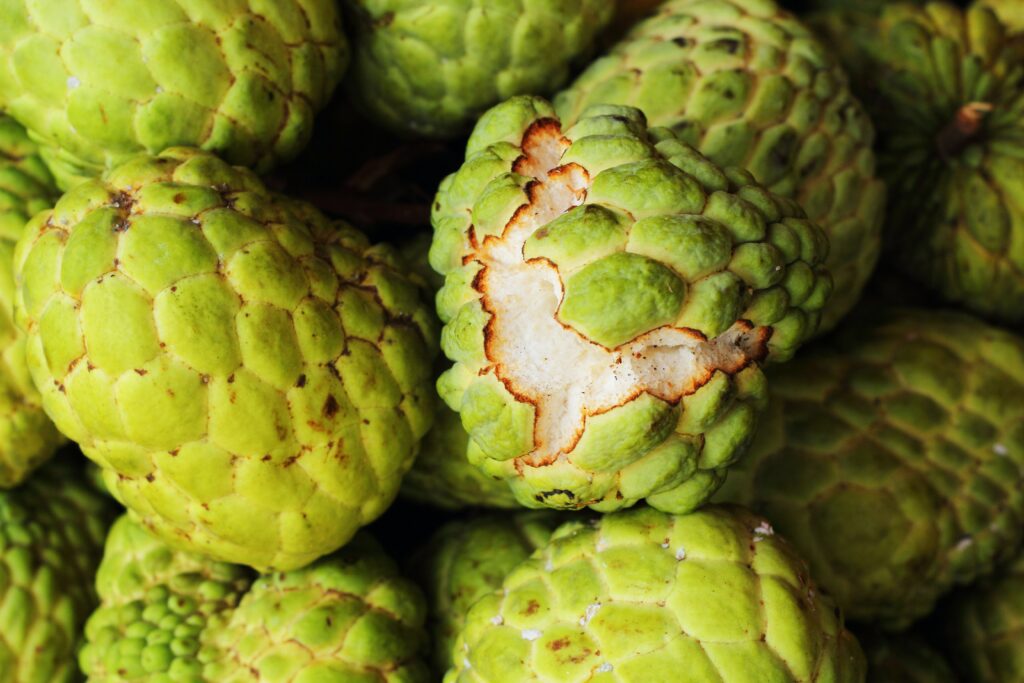
The Sugar Apple, a fruit slightly larger than a tennis ball, is another fruit you must try in Thailand. It’s easily recognized by its knobby green skin that can be pulled apart when ripe, revealing dozens of fleshy white segments inside, each containing a seed.
The flesh has a creamy texture, and the seeds are easy to remove – just spit them out one by one.
Often referred to as the Custard Apple or Sweetsop, the Sugar Apple offers a taste that is reminiscent of creamy custard. I love eating sugar apples cold!
How to Eat Sugar Apple: Pull apart the ripe sugar apple with your hands. The easiest way to eat a Sugar Apple is with a spoon. Simply scoop the segments into your mouth, savoring the creamy, custard-like taste. Be sure to spit out the seeds.
Thai name for Sugar Apple: Noina (น้อยหน่า)
Sugar Apple Season in Thailand: June to September
👉 One of my favorite ways to learn about local food and fruit when I’m traveling is to take a food tour or cooking class. Tours are a really fun way to meet other travelers, and I find food tours to be more social than other types of tours.🧑🍳🥘🍜🍡🌶️
13. Snake Fruit (Salak)

The Snake Fruit, or Salak, is a species of palm native to Indonesia but has found its home in Thailand as well.
Roughly the size of a fig, this Thai fruit is easily recognizable by its unique skin, which looks like snake scales – hence the name.
Don’t be put off by its exterior; inside, you’ll find a sweet and tart pulp that’s dry yet incredibly crunchy. I would describe the flavor of snake fruit as a mixture of banana, pineapple, and apple. It leaves a citrusy feeling on your tongue.
Locals enjoy eating salak raw, often dipping it in a mixture of salt and sugar for an extra kick of flavor.
When choosing a good Snake Fruit, look for the ones with the brightest colors, a slightly firm feel, and a sweet smell.
Be careful of eating too much snake fruit – locals believe eating excessive amounts of salak causes constipation (I’ve yet to have that problem in Thailand, even though I sometimes wish I did!).
How to Eat Snake Fruit: Break the tip and easily pull the thin skin away. You’ll find three lobes of fruit inside (they kind of look like garlic), each with a large seed. Simply pop a lobe into your mouth, enjoy the crunch, and spit out the seed.
Thai name for Snake Fruit: Salak (สละก)
Snake Fruit Season in Thailand: Available Year-Round in Southeast Asia
14. Rose Apple

Also referred to as the wax apple, rose pear, or mountain apple, the Rose Apple is a Thai fruit that is bell-shaped and has a waxy texture.
In Thailand, the lighter green variety is more typical, but you might also come across some that are vibrant red.
The Rose Apple is crunchy, much like an apple or pear, but with a juiciness that is unparalleled. It’s actually more similar to a guava than it is to an apple.
And, it’s good for your heart, immunity, and digestion, and helps control diabetes.
I love eating rose apples on a hot day in Thailand. Its interior, similar to an apple, has a core, but with more fleshy and watery content, perfect for keeping you hydrated in the tropical sun. If you imagine a regular red apple saturated in water for a bit, it’s close to the Rose Apple experience.
How to Eat Rose Apple: The skin of the Rose Apple is edible. Enjoy it raw, perhaps with a touch of salt and sugar to enhance its natural sweetness, or use it in a salad for a unique twist.
Thai name for Rose Apple: Chompoo (ชมพู่)
Rose Apple Season in Thailand: Available Year-Round
15. Jackfruit

Before setting foot in Thailand, my experience with jackfruit was limited to its cooked version, utilized as a meat substitute in vegan dishes. However, tasting it raw completely changed my perspective.
Jackfruits are enormous, some reaching almost a meter (3 ft) in length and weighing up to 40 lbs (18 kg). It’s so crazy seeing dozens of them growing on a tree!
But don’t let that intimidate you, as most vendors dissect these giants into manageable portions for your convenience.
The jackfruit has a thick rind on the outside and yellow segments inside, each with a seed. It has a unique combination of sweetness, dry texture, and meaty crunch. Jackfruit is versatile and can be enjoyed raw or cooked in savory or sweet dishes. They’re high in potassium and other vitamins.
How to Eat Jackfruit: Enjoy the flesh raw or use it as an ingredient in a variety of Thai dishes. Beware of the sticky sap when handling a whole jackfruit (and be extra cautious if you have a latex allergy); it’s often easier to let the vendors do the hard work!
Thai name for Jackfruit: Kanoon (ขนุน)
Jackfruit Season in Thailand: Available from January to May, making it a perfect treat for the dry season.
16. Star Fruit

Star fruit, also known as Carambola or “5 fingers,” is a beautiful Thai fruit that makes any fruit salad Instagram-ready.
With its five ridges running along the sides, when cut crosswise, the slices look like perfect little stars, hence the name.
It has a crunchy texture, and its flavor is a unique blend of sweet, tart, and slightly sour. It’s a refreshing treat on a hot day.
I would describe the flavor of star fruit as a mixture of orange, grapefruit, and papaya. Some people say it’s a combination of lemon and pineapple flavors.
How to Eat Star Fruit: Simply slice it crosswise into star-shaped pieces and eat it as is. The skin is edible. Alternatively, it can be used in juices or preserves.
Thai name for Star Fruit: Ma fueng (มะเฟือง)
Star Fruit Season in Thailand: The star fruit season runs from October to December.
17. Gac

At first glance, you might mistake the Gac melon fruit for a decorative piece, thanks to its strikingly vivid orange-red color and small thorns adorning its skin.
Shaped round or oblong, this fruit’s exterior might give the impression that it’s tough to crack, but within its firm orange rind lies a world of mild, dense flesh and exotic taste.
While Gac is less common in Thailand and more typical in Vietnam, its mild flavor makes it an intriguing pick among the tropical fruits of Thailand.
Despite its rather plain taste, Gac surprises with its innards that look somewhat similar to pomegranate seeds – a yellow fruit with red seeds that are encased in a slimy, blood-red pulp.
Its unique texture and taste lend themselves well to being enjoyed as a juice, though it can be eaten raw as well. In Vietnam, the fruit is used to create red sticky rice for special occasions, while in Thailand, it’s often found in juices blended with other fruits.
How to Eat Gac: Cut open the firm orange rind to reveal the seeds and pulp within. It’s safe to eat raw, but it’s almost flavorless so most people don’t. You’re not supposed to eat the seeds.
Thai name for Gac Fruit: Fak khao (ฟักข้าว)
Gac Fruit Season in Thailand: The Gac fruit season runs from December to January. So if you’re planning to traverse the Thai landscape during these months, don’t miss out on trying this exotic fruit!
Best Booking Sites:
The two best places to read reviews and book hostels and hotels are HostelWorld and Booking.com.
18. Makok Fruit (Hog Plum)

Makok, or hog plum, is a small, green fruit that may remind you of an unripe mango at first glance, albeit smaller.
European traders brought it to Asia from the Caribbean and South America. Although not native to Thailand, it has become one of the main fruits in the region. I’ve never really heard anyone mention it!
The fruit contains a pit in the center that needs to be carefully removed, much like a mango. With a taste reminiscent of a Granny Smith apple, it carries a sharp, acidic flavor that mellows as it ripens, transitioning from sour to sweet.
Some compare the taste to a June plum or an intriguing blend of peach and apricot.
The fruit flesh can be savored fresh or incorporated into juices, jellies, or even ice creams. It is also frequently used in pickling, or added to papaya salads in its unripe stage for an added crunch.
How to Eat Makok: Carefully cut around the pit (like you would cut a mango).
Thai name for Makok Fruit: Makok (มะกอก)
Makok Fruit Season in Thailand: July through September
19. Chico Fruit (Chiku)

Also referred to as sapodilla, chikoo, or sapote, the chico fruit is not originally from Thailand but has made itself at home in this tropical paradise. Native to Mexico and Central America, I had my first encounter with this unique fruit on a food tour in El Salvador.
The chico fruit, though not particularly pleasing to the eyes with its oval shape and dull brown skin, packs a surprise with its delightfully sweet taste.
The dark-colored outer peel encases an edible orange or reddish flesh that tastes similar to a mix of sweet potato, pumpkin pie, and cantaloupe.
The fruit, with its velvety, soft flesh, is best savored fresh, though it could also be a flavorful addition to smoothies or ice creams.
How to Eat a Chico Fruit: Let it ripen until it’s a bit soft, like an avocado. Cut it in half, remove the pit, and scoop out the flesh with a spoon.
Thai name for Chico Fruit: Lamut (ละมุด)
Chico Fruit Season in Thailand: September to December
20. Thai Plum Mango (Marian Plum)

The plum mango, also known as the Marian plum, is a small tropical fruit closely related to mangoes and cashews.
At first glance, this small fruit in Thailand may resemble a miniature ripe mango, but once you take a bite, you’ll immediately notice the distinctive taste.
The interior of the mango is vibrant orange, soft, and jelly-like, with a slightly fibrous texture that adds a unique mouthfeel. In terms of taste, it is more sour than traditional mangoes, striking a perfect balance between sweetness and tartness.
This fruit is generally enjoyed raw, with some preferring to eat it with the skin for an added crunch, while others prefer it without.
How to Eat a Plum Mango: You can just bite into this fruit, or you can cut it along the pit like you would cut a mango.
Thai Name for Plum Mango: Maprang (มะปราง)
Plum Mango Season in Thailand: April to May
👉 Find the best local tours with this search engine (and the best deals)!
21. Jujube (Putsa Apple)

The Jujube, commonly referred to as the Putsa Apple, is a unique fruit that may initially remind you of crab apples. These Thai fruits are sometimes called Thai apples due to their similar appearance but they possess a more sour and tart flavor profile than any crab apple.
Jujubes come in various shapes and sizes, ranging from small, cherry-sized spheres to larger, plum-sized fruits that are more elongated in shape. The thin, edible skin wraps around a whitish, sweet interior, offering a delightful contrast of flavors.
Unlike most fruits, Jujubes are not typically enjoyed raw in Thailand. Instead, they are often dried and used to make a refreshing tea. This practice might seem odd to some, but after seeing Sarah Ahn (@ahnestkitchen) on Instagram share how her family harvests Jujubes from their backyard in California for tea-making, you might be inspired to give it a try!
How to Eat a Jujube: The Putsa Apple is best enjoyed dried and steeped in boiling water to make a soothing tea. However, if you’re feeling adventurous, you can certainly try it raw.
Thai Name for Jujube: Phutsa, pute saa (พุทรา)
Jujube Season in Thailand: Year-Round
22. Passion Fruit

Passionfruits in Thailand have a bright, sweet-sour flavor that’s incredibly refreshing.
Botanically, it’s considered a large berry, and each seed is surrounded by a sac filled with juice, creating a texture that’s more liquid than a pomegranate and brimming with a unique flavor. You’ll find both yellow and purple-skinned passion fruits in Thailand, with the purple variety being the most common and often sweeter.
My personal favorite way to relish this delightful fruit is mixed in soda (my favorite sushi restaurant in Chiang Mai does it best)!
If you’re up for a straight-from-the-source experience, cut the passion fruit in half and scoop it out with a spoon, or you could even just drink it right out of the skin like a cup. It’s also often used in smoothies, making for a perfect tropical treat.
How to Eat a Passion Fruit: This Thai fruit can be sliced in half and the juicy interior can be scooped out with a spoon, or you can even drink it right out of the skin. It’s also fantastic when used in smoothies.
Thai Name for Passion Fruit: Saowarot (สาวรส)
Passion Fruit Season in Thailand: End of autumn and through winter.
23. Mangoes

Cut the sides off first, there’s a really big seed that you can’t eat – you’ll feel it with your knife if you try to cut through it
Mangoes, the quintessential Thai fruit, offer a succulent, sweet, and sometimes tangy flavor that is truly unparalleled.
Thailand is renowned for its mangoes, particularly the Nam Dok Mai variety, which is revered for its sweet, robust flavor and smooth texture.
While ripe, yellow mangoes are a classic favorite, do not miss out on tasting the unripe, green mangoes. The tart punch of a green mango offers a refreshing contrast and is often used in Thai salads or served with a spicy chili-salt dip.
Additionally, mangoes are a primary ingredient in the famous Thai dessert, mango sticky rice, where the sweetness of ripe mango is paired perfectly with sticky, coconut-infused rice. You’ll find mango sticky rice at every local night market in Thailand, and you should always get it.
How to Eat a Mango: The best way to enjoy a mango is to first remove the sides as there’s a large, inedible seed in the center. You can then slice or dice the mango flesh as you prefer. I must admit, I still have a tough time neatly cutting mangoes! But don’t let that stop you – the deliciousness of a Thai mango is well worth the effort.
Thai Name for Mango: Mamuang (มะม่วง)
Mango Season in Thailand: Typically, mangoes are available throughout the year, with the peak season from March to June.
24. Papaya

Known locally as “Malakor” (มะละกอ), this omnipresent Thai fruit is as nutritious as it is delicious. The flesh of the ripe papaya is sweet, creamy, and luscious, while the unripe papaya serves as the star ingredient in the famous Thai salad, Som Tam.
A ripe papaya will feel soft to the touch, and its skin will have an orangish hue. To eat it, slice it lengthways and use a spoon to scoop out the black seeds. You can then spoon out the vibrant orange pulp straight from its skin.
One full papaya lasts for several hearty breakfasts for me, and I often buy one to eat when I’m staying in hostels.
Unripe papayas, however, are firm and green, and when shredded and mixed with lemon juice, chilies, peanuts, and dried shrimp, make a refreshing Thai salad. I order “Som Yam” nearly every day when I’m in Thailand (and I always ask for just one chili because it gets too spicy for me!).
How to Eat a Papaya: Cut the papaya in half lengthways and use a spoon to scoop out the seeds. You can then either slice the papaya or scoop out the flesh with a spoon. Remember, a large papaya can feed you for several meals, making it a cost-effective choice for budget travelers.
Thai Name for Papaya: Malakor (มะละกอ)
Papaya Season in Thailand: Papayas are available all year round, given Thailand’s tropical climate.
25. Thai Bananas

Thai bananas offer a distinct taste and texture that sets them apart from their Western counterparts. They taste more like bananas, if that makes sense – because they’re so much fresher!
These bananas are typically smaller, but their flavor is more concentrated and richer. Particularly popular are Thai finger bananas, which are bite-sized with a sweet, creamy taste.
You’ll find them readily available at street stalls, fruit markets, or even as a part of your hotel breakfast. Don’t miss the chance to try banana chips, a crispy, sweet, and slightly salty snack that’s perfect for on-the-go munching.
Thai bananas are not only about the fruit itself. Banana leaves serve an eco-friendly purpose, often used as a wrapping material for various Thai street foods instead of plastic. These leaves preserve the freshness of food and add a subtle, distinct flavor.
A trip to Thailand will also introduce you to irresistibly fresh banana smoothies, a common sight at local juice stalls.
How to Eat a Thai Banana: Simply peel and eat. Look out for banana chips at local markets and fresh banana smoothies at juice stalls.
Thai Name for Banana: Gluay (กล้วย)
Banana Season in Thailand: Bananas are available all year round.
👉 I LOVED my Thai cooking class so much (and it included a market tour!) – check out the best cooking classes in Thailand! 🧑🍳
26. Thai Tangerines

Thai tangerines, with their unique bright green exterior, might surprise first-time visitors due to their resemblance to limes. However, these are actually ripe tangerines and they boast a refreshingly juicy, tangy-sweet flavor.
Thailand is home to several different varieties of tangerines (not just the green ones), each offering a unique twist to the common citrus taste we’re familiar with.
Just like Thai bananas, tangerines are a common sight at local markets and street stalls. For a truly Thai experience, don’t pass up the chance to try them freshly peeled or squeezed into a revitalizing juice, perfect for beating the tropical heat.
The tangerine, like many fruits in Thailand, is more than just a tasty treat. Its bright peel is often used as a natural food coloring in Thai desserts, while the zest adds a tangy punch to a variety of Thai dishes.
How to Eat a Thai Tangerine: Simply peel and eat. You can also enjoy tangerine juice, commonly available at local juice stalls.
Thai Name for Tangerine: Som Keaw Wan (ส้มเขียวหวาน)
Tangerine Season in Thailand: You’ll find the sweetest mandarins from January to April.
27. Thai Coconuts

Thai coconuts are a refreshing, healthy treat, found on nearly every corner across the country and available throughout the year.
Vendors often sell young coconuts – you just pop in a straw and sip deliciously sweet coconut water straight from the fruit. Find vendors who keep their coconuts on ice for a nice cold coconut water to drink.
The vendor will happily crack the husk open for you once you’ve finished your drink, allowing you to enjoy the tender, flavorful flesh with a spoon.
Coconuts hold a special place in Thai cuisine. They are used in a variety of dishes, from rich, creamy curries to sweet desserts and smoothies. The versatility of the coconut is a testament to the creativity and resourcefulness of Thai cooking.
I love getting the homemade coconut ice cream at Phuak Night Market in Chiang Mai – yum!
How to Eat a Thai Coconut: Drink the coconut water straight from the fruit. Once finished, ask the vendor to cut it open so you can scoop out and eat the tender flesh. You can also find it in a range of Thai dishes.
Thai Name for Coconut: Ma-Praow (มะพร้าว)
Coconut Season in Thailand: Available all year round.
28. Pineapples

Thai pineapples are notably sweet, juicy, and incredibly flavorful, making them a must-try for every traveler visiting Thailand.
The pineapples found in Phuket are particularly renowned for their enhanced sweetness and juiciness compared to their northern counterparts.
Thailand’s status as one of the largest pineapple producers in the world can be attributed to the country’s sandy seacoast soil, which provides optimal conditions for pineapple cultivation. These delicious fruits can be found everywhere around the country, with cute miniature pineapples being a common sight in grocery stores.
Pineapples are not only eaten fresh but also used extensively in Thai cuisine. From desserts and refreshing drinks to savory dishes like pineapple fried rice, the Thai pineapple’s versatility is truly admirable.
How to Eat a Thai Pineapple: Pineapples are often sliced and eaten fresh, or used in a variety of dishes and drinks. Looking for a truly Thai experience? Try the pineapple fried rice!
Thai Name for Pineapple: Sapparot (สับปะรด)
Pineapple Season in Thailand: February to June and October to December
👩🍳 My pick for the best cooking class in Chiang Mai is Benny’s Home Cooking course with a small class size, robust menu, and a near-perfect 5-star rating!
29. Watermelons

Is there anything better than sitting at your hotel’s rooftop pool after a long day of sightseeing, and snacking on juicy watermelon? No, there’s not!
I find watermelons in Thailand to be larger and sweeter than the ones back home. And a lot more seeds.
Watermelons in Thailand are grown year-round, thanks to the country’s warm tropical climate, and are a common sight at local markets, roadside stalls, and even in five-star hotels as part of their breakfast buffet.
The fruit is often served chilled in slices, or in refreshing drinks, salads, and even in some traditional Thai dishes.
How to Eat a Thai Watermelon: Watermelons are typically sliced and eaten fresh, although you can also find them juiced or in fruit salads. For a unique Thai experience, try watermelon with a pinch of salt – a common way locals enjoy this fruit.
Thai Name for Watermelon: Taeng-Mo (แตงโม)
Watermelon Season in Thailand: Available all year round.
Food Tours and Cooking Classes: My Gateway to Thai Cuisine and Culture
Eating is my favorite way to explore a new country, and I strongly recommend travelers to Thailand take a cooking class or food tour when they’re here. Thailand has some of the best cuisine in the whole world, but it can be a little intimidating when you first arrive.
These tours and classes are not just about food, they’re a fascinating window into Thai culture, traditions, and the local way of life.
As a solo traveler, I’ve found that these tours are a fantastic way of connecting with people. I’ve never had a bad time on a food tour or in a cooking class!
If you’re planning a trip to Thailand, I highly recommend integrating a food tour or cooking class into your itinerary.
Popular Thai Vegetables

Thailand’s rich culinary landscape is not just about its famous fruits but also its diverse vegetables.
As a traveler traversing through the local markets and street-side stalls, here are some common vegetables you will encounter.
- Asparagus: A versatile vegetable that often finds its way into stir-fries and salads.
- Okra: Loved for its unique texture, okra is a staple in many Thai dishes, such as soups and curries.
- Baby Corn: Perfect for a crunchy bite, baby corn is a favorite in many stir-fry dishes.
- Ginger: A key ingredient in Thai cuisine, ginger brings a spicy, aromatic touch to many dishes.
- Chili: Thais love their spice, and chili peppers, in all their varieties, are a must in any kitchen.
- Soybeans: Used in various forms, from fresh to fermented, soybeans play an essential role in Thai cuisine.
- Cauliflower and Cabbage: These cruciferous vegetables are often used in salads, stir-fries, or as accompaniments to main dishes.
- Tomatoes and Cucumbers: Beyond salads, these refreshing vegetables are often used in a variety of dishes, including the famous ‘Som Tam’ or green papaya salad.
- Legumes: From long beans to lentils, legumes are commonly used in Thai dishes for their nutritional value and hearty texture.
The Importance of Cleaning Fruits and Vegetables in Thailand

While exploring the vibrant flavors of Thailand’s fruit and vegetable offerings, it’s essential to remember one crucial aspect – cleaning.
Ensuring your fruits and vegetables are clean before you consume them is a step that must not be overlooked for the sake of your health. Despite the tempting array of fresh produce in Thailand, it’s important to note that they might have been exposed to various environmental factors, handling, and sometimes pesticides.
Cleaning your produce thoroughly removes potential residues and reduces the risk of foodborne illnesses.
Now, here’s a practical hack that I often use when in Thailand – a vinegar water bath. Vinegar is a natural disinfectant and is excellent for cleaning fruits and vegetables.
Here’s how you can do it:
- Fill a large bowl with water (tap water is fine to use in this case, but it’s not safe to drink).
- Add a splash of vinegar. The ideal ratio is roughly one part vinegar to three parts water, but a little extra vinegar won’t hurt.
- Place your fruits or vegetables in the bowl, ensuring they’re fully submerged.
- Allow them to soak for a couple of minutes. This soak will help to break down residues and kill off any microorganisms.
- After soaking, rinse the produce thoroughly under running water.
And there you have it – clean, safe, and ready-to-eat Thai fruits and vegetables.
👉 Find the best local tours with this search engine (and the best deals)!
Thailand Fruits FAQs

What is the difference between rambutan and lychee?
The difference between rambutan and lychee lies in their appearance and taste. Rambutan has hair-like spikes and sweet flesh, while lychee has smooth skin and fragrant, juicy flesh.
What fruit is popular in Thailand?
The most popular fruits in Thailand are the durian, known for its unique taste and strong aroma, and the mangosteen, known for its sweet and tangy flavor. You’ll also find coconuts, mangoes, and dragon fruit widely enjoyed in Thailand.
What is the national fruit of Thailand?
The national fruit of Thailand is the mangosteen. It is highly regarded for its sweet and tangy flavor, as well as its numerous health benefits.
Are Thai fruits safe to eat?
Yes, Thai fruits are generally safe to eat. However, it’s important to properly wash and prepare them before consuming them to avoid any potential contamination. As with any fruit or vegetable, make sure to rinse them thoroughly before eating.
How do you eat a mangosteen?
To eat a mangosteen, simply press the skin between two fingers until it cracks. Then, remove the top portion of the skin and enjoy the segments inside like you would an orange. Watch out for seeds!
What is the spiky fruit in Thailand?
The spiky fruit in Thailand refers to the durian, often called the “king of fruit” for its distinctive appearance and taste.
What is the king of fruit in Thailand?
Durian is often called the “king of fruit” in Thailand.
What is the round brown fruit in Thailand?
The round brown fruit in Thailand is the longan, which has sweet and juicy flesh.
What is the big citrus fruit in Thailand?
The big citrus fruit in Thailand is the pomelo, known for its large size and refreshing taste.
Which fruit is called shampoo in Thailand?
The fruit called shampoo (or “chompoo”) in Thailand is tamarind, used in traditional recipes and known for its tangy flavor.
Conclusion: Fruits of Thailand
A trip to Thailand isn’t complete until you’ve visited a local market and tasted exotic Thai fruits that you’ve never seen or heard of before. Only a small percentage of fruits from Thailand are exported, so you have to come to Thailand to enjoy the wide selection of exotic fruits!
Thailand’s rich agricultural landscape, spanning over 21 million hectares, makes it an ideal hub for tropical fruit production, ranking among the world’s largest providers.
A few fruits in Thailand you should taste are longan, durian, mangosteen, rambutan, mango, and longkong.
Remember, if any fruits look artificially colored, stay away (some vendors dip them in dye, but it’s not good for you).
The best place to experience this is at the local fruit market.
If you’re headed to my favorite city in Thailand, Chiang Mai, then you’ll have to visit my favorite fruit market! Far from the usual tourist trails, this market offers a real, authentic insight into Thai life. Here, you can find the freshest, highest-quality fruits at unbeatable prices.
And if you need some dried fruits for your backpack, try a local market like Warorot Market in Chiang Mai.
Read More About Thailand:
- Ultimate 14-Day Thailand Itinerary: 2 Epic Weeks in Thailand
- Bangkok vs Chiang Mai: Which Thai City Is Best for You?
- 3 Day Chiang Mai Itinerary: Solo Traveler’s Guide
- Ultimate Chiang Mai Travel Guide for Solo Travelers
- Ultimate Money Guide to Cash, Cards, & ATMs in Thailand
- Is Thailand Safe For Solo Female Travelers? + Safety Tips and Scams
- Caution: Avoid the Worst Time to Visit Thailand
- Do You Need a Motorcycle License in Thailand?
- 15 Must-Know Tips for Renting a Scooter in Thailand
- Best SIM Card in Thailand for Tourists
- Is There Uber in Thailand? Ultimate Ride-Sharing Guide
- Chiang Mai vs Chiang Rai: Which Is Better to Visit?
- 29 Delicious Thai Fruits You Must Try (And How to Eat Them)
- Extending Your Thailand Visa in 3 Easy Steps + Expert Tips
- Are Taxis Safe in Thailand? 21 Tips from a Local
- Thailand Vs Vietnam: Choose Your Next Destination Wisely
- How Long Does it Take to Get to Thailand?
- 37 Pros and Cons of Living in Chiang Mai (Expat Guide)
Read More About Markets and Food in Chiang Mai:
- Best Chiang Mai Food Tour for Foodies (Beyond Pad Thai!)
- 9 Best Chiang Mai Cooking Classes (By a Local Foodie!)
- Best Khao Soi in Chiang Mai: 15 Must-Try Restaurants
- Chiang Mai Sunday Night Market with Insider Food Tips
- Gate Market Chiang Mai: Ultimate Guide
- 11 Best Chang Phuak Gate Night Market Food Stalls
- Chiang Mai University Night Market: Best Local Eats
- Warorot Market (Kad Luang): A Local Foodie’s Guide
- Ton Lamyai Market: Best Chiang Mai Flower Market Guide
- 29 Delicious Thai Fruits You Must Try (And How to Eat Them)
- Mueang Mai Market: Largest Fruit Market in Chiang Mai
- 17 Best Foods in Chiang Mai: Chiang Mai Food Guide
📝 Thailand Travel Planning Guide 🇹🇭🌟
Before you embark on your unforgettable journey to Thailand here are the essential tips every traveler should know:
🚑 Should I buy travel insurance for Thailand?
✅ 100% YES! — My #1 Safety Tip for all travelers is to buy travel insurance for every trip in case anything happens on their visit. I recommend and use SafetyWing – it’s cheap and comprehensive.
💧Can you drink the water in Thailand?
🚱 No — It’s recommended to drink filtered or bottled water in Thailand (but using tap water to brush your teeth is usually fine). I recommend this reusable water bottle! It works great, turning tap water into safe-to-drink water that tastes good.
🚙💨 Is it safe to rent a car in Thailand?
Yes — Renting a car in Thailand is one of the best ways to see the countryside! I recommend Discover Cars, which checks both international companies and local companies, so you get the best rates.
🏩 What’s the best way to book my Thailand accommodations?
My go-to for Thailand hotels is Booking.com. For hostels, I use HostelWorld. Or get free accommodations with Trusted Housesitters!
✈️ What’s the best site to book Thailand flights?
For finding cheap Thailand flights, I recommend CheapOAir.
🎫 Do I need a visa for Thailand?
🙅🏻♀️ Likely Not — US, UK, and EU passport holders don’t need visas for stays of up to 30 days in Thailand.
💰 𝗖𝘂𝗿𝗿𝗲𝗻𝗰𝘆: The currency here is the Thai baht, and there are plenty of ATMs if you need cash. I always withdraw from ATMs to get the best rates (select “no” when it asks you if you accept the conversion rate).
🚕 𝗧𝗿𝗮𝗻𝘀𝗽𝗼𝗿𝘁𝗮𝘁𝗶𝗼𝗻: Getting around Thailand is a breeze! Grab is safe and cheap in major cities like Bangkok and Chiang Mai. Bangkok has a modern metro. It’s easy to use local transport such as songthaews, too.
📶 𝗖𝗼𝗻𝗻𝗲𝗰𝘁𝗶𝘃𝗶𝘁𝘆: Thailand has reliable internet connectivity. SIM cards are easy to find and cheap.